
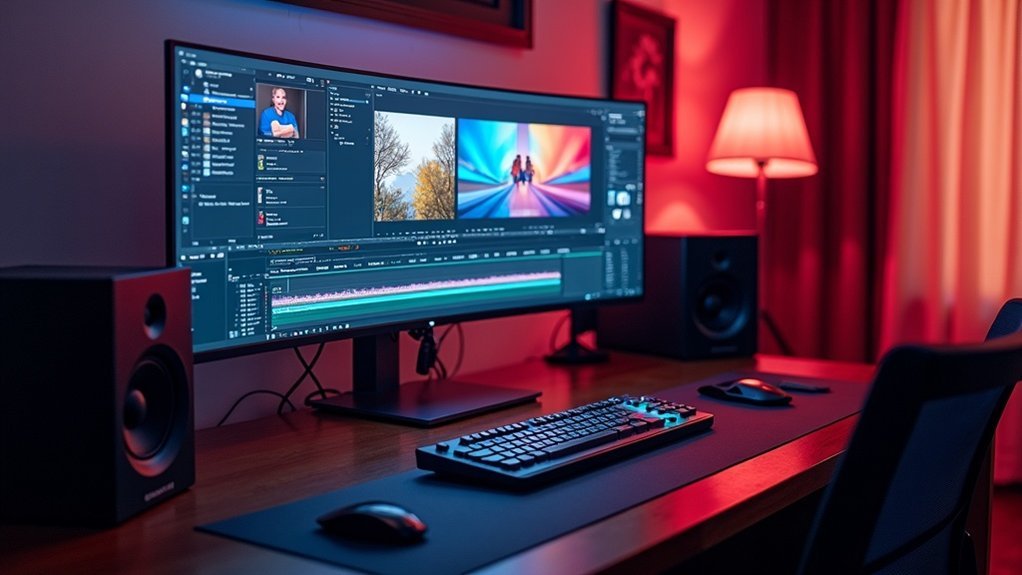
For video editing, you should typically use a gamma setting of 2.2 for a balanced representation of shadows and highlights. If you’re in a bright environment, consider bumping it up to 2.4 for improved contrast. In dimly lit rooms, lowering it to around 2.0 to 2.2 can prevent harsh contrasts. Regular calibration every 1-2 months is essential for maintaining accuracy. Keep exploring to discover how to optimize your editing setup further for the best results.
Key Takeaways
- Use a gamma setting of 2.2 for balanced shadows and highlights in standard video editing environments.
- In bright environments, set gamma to 2.4 to maintain contrast and detail in your footage.
- For dimly lit rooms, lower gamma to between 2.0 and 2.2 to avoid harsh contrasts.
- Regularly calibrate monitors every 1-2 months to ensure accurate gamma settings and color representation.
- Always verify export settings match project gamma specifications to prevent image distortion.
Understanding Gamma in Video Editing
When you plunge into video editing, understanding gamma is vital for achieving ideal visual quality.
The typical gamma setting of 2.2 strikes a balance between shadows and highlights, perfect for most viewing environments. For HDR content, you might want to take into account 2.4 to enhance dynamic range and contrast.
It’s essential to regularly calibrate your monitors every 1-2 months to maintain accurate gamma settings, ensuring consistent color grading results.
Additionally, adjusting gamma based on your editing environment’s lighting can considerably influence visual quality, with subdued lighting recommended for better color perception during your editing sessions.
Importance of Gamma Correction
Gamma correction plays an essential role in ensuring that what you see on screen accurately reflects your creative vision.
By compensating for the non-linear relationship between pixel values and brightness, it maintains color accuracy across various devices. Applying the correct gamma prevents images from appearing too dark, too bright, or skewed in color balance, considerably enhancing visual quality.
A recommended gamma value of 2.2 offers a balanced representation of shadows and highlights, ideal for most displays. Regularly calibrating your monitor to this target helps preserve detail and color accuracy, which is crucial in any professional video editing workflow.
Recommended Gamma Settings for Different Environments
Choosing the right gamma setting for your editing environment is essential to achieving ideal visual fidelity.
Here are some recommended gamma settings based on various conditions:
- Standard Lighting: Use a gamma value of 2.2 for a natural balance between shadows and highlights.
- Bright Environments: Opt for a higher gamma setting of around 2.4 to maintain contrast and detail.
- Dimly Lit Rooms: A lower gamma setting of 2.0 to 2.2 helps prevent harsh contrast.
- Broadcast Content: Stick to a gamma of 2.4, while cinemas prefer 2.6 for enhanced depth.
Consistency is key across platforms!
Setting Up Gamma in Video Editing Software
Achieving the right visual fidelity in your edits requires not just awareness of gamma settings but also a solid understanding of how to properly set them up in your video editing software.
Start by accessing Project Settings in DaVinci Resolve, selecting “DaVinci YRGB Color Managed,” and unchecking “Automatic color management” for precise gamma adjustment.
Access Project Settings in DaVinci Resolve, choose “DaVinci YRGB Color Managed,” and disable “Automatic color management” for precise gamma adjustments.
Set the Timeline color space to “Da Vinci Wide Gamut Intermediate” to maximize Dynamic Range. Choose the correct Input Color Space, like LogC3 for ARRI footage, to guarantee consistency.
Regularly revisit these settings, adapting them based on your content and viewing environment for ideal results.
Monitor Calibration for Accurate Gamma
When you’re diving into the world of video editing, guaranteeing your monitor is properly calibrated is essential for accurate gamma representation.
Follow these steps for ideal gamma setting:
- Invest in quality calibration tools like the X-Rite i1Display Pro or SpyderX Pro.
- Allow your monitor to warm up for at least 30 minutes before calibration.
- Perform the calibration in typical lighting conditions, avoiding direct sunlight.
- Set your target gamma to 2.2 for a natural balance between shadows and highlights.
Regularly recalibrating every 1-2 months guarantees sustained color accuracy and effective gamma representation in all your video projects.
Troubleshooting Common Gamma Issues
When you encounter gamma issues in your video editing, start by ensuring all devices are calibrated to the same standard for consistent color representation.
Next, verify your export settings to match your project’s gamma specifications, as mismatches can distort your final output.
Finally, leverage software-specific color management tools to effectively address any gamma handling problems during editing and exporting.
Calibration Consistency Across Devices
To maintain consistent color representation across various devices, it’s essential that you calibrate each monitor to a unified gamma standard, typically set at 2.2 for video editing.
Here’s how to guarantee calibration consistency:
- Calibrate my monitor regularly to the right gamma using reliable software.
- Create multiple profiles for different lighting conditions to adapt as needed.
- Utilize color management options specific to your editing software to preserve gamma settings.
- Adjust for display technology differences, like CRT versus LCD, to achieve accurate color representation.
Following these steps will enhance your video editing experience and maintain visual quality.
Export Settings Verification
Calibration consistency is only the first step in achieving accurate color representation in video editing.
You must conduct thorough export settings verification to guarantee your gamma aligns with the intended output. Incorrect settings can lead to unwanted gamma shifts in your final file.
Always check that your chosen color space matches your editing timeline; mismatches can cause unexpected changes. Be aware of software-specific color management options that may influence gamma handling as these vary between applications.
To maintain accuracy, consider creating multiple calibration profiles for different export scenarios, assuring ideal visual quality across various platforms.
Software Color Management Options
While steering through the complexities of video editing, you’ll encounter various software color management options that can greatly impact gamma performance.
Here are some key steps to reflect upon:
- Calibrate all devices to the same gamma standard to avoid inconsistencies.
- Double-check your export settings to prevent undesired gamma shifts.
- Utilize software-specific options, like DaVinci Resolve’s color science, to tackle gamma handling issues.
- Create multiple calibration profiles for different lighting conditions, ensuring dark areas retain detail and clarity.
The Impact of Gamma on Gaming Experience
Gamma settings play a crucial role in shaping your gaming experience, as they directly influence contrast and visibility within the game world. Correct adjustments help you spot enemies and critical objects, enhancing gameplay.
If gamma settings are off, you may encounter unrealistic colors, detracting from immersion and aesthetic appeal. Proper calibration is especially important for HDR games, allowing for a broader dynamic range and richer visuals.
Additionally, optimized gamma can give you a competitive edge in multiplayer scenarios by improving clarity in darker areas. Just like in video editing, precise gamma settings enhance the overall atmosphere and engagement in gaming.
