
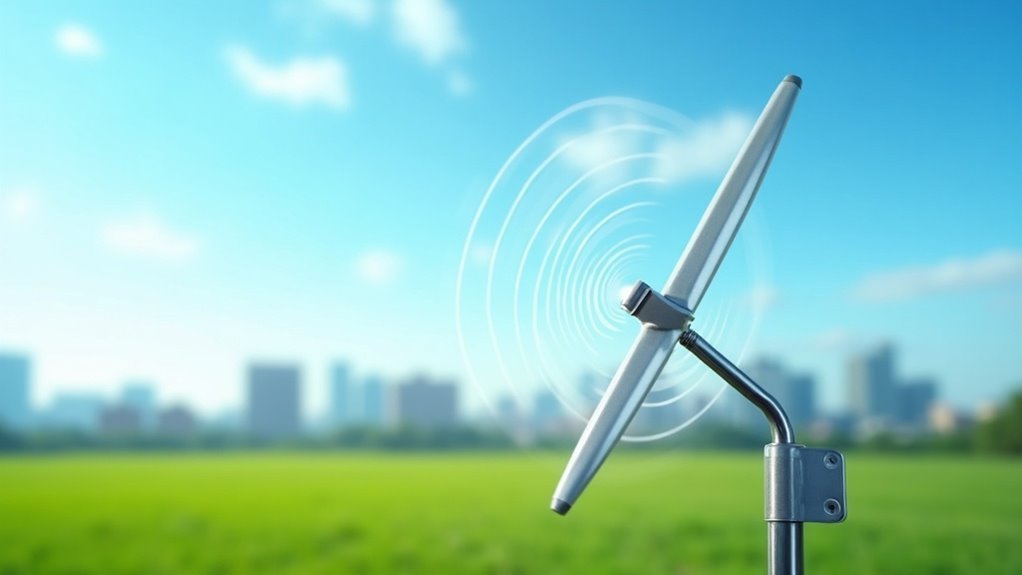
Antenna orientation matters for signal quality because it directly affects reception strength and clarity. Proper alignment with the transmitting source maximizes gain and minimizes loss, reducing interference and multipath issues. Even minor adjustments in angle or height can lead to significant improvements in signal-to-noise ratio. Additionally, environmental factors like terrain and obstacles can impede performance. Understanding these dynamics is essential for ideal antenna setup, and there’s more to learn about ensuring the best signal quality.
Key Takeaways
- Proper antenna orientation aligns with the signal source, maximizing gain and minimizing loss for better reception quality.
- Incorrect polarization can result in significant signal loss, affecting overall performance by up to 20 dB.
- Clear line of sight to the transmitting source is crucial to avoid multipath interference and enhance signal strength.
- Environmental factors, such as terrain and obstacles, necessitate regular adjustments to maintain optimal antenna positioning.
- Minor adjustments in angle or height can lead to substantial improvements in signal clarity and quality.
Importance of Antenna Orientation
When you align your antenna properly, you’re not just tweaking a piece of equipment; you’re greatly enhancing your signal quality.
The importance of antenna orientation can’t be overstated. By adjusting antenna direction to match the transmitting source, you maximize gain while minimizing interference.
Proper antenna orientation is crucial; aligning it with the transmitting source enhances gain and reduces interference significantly.
Incorrect polarization can lead to a signal loss of up to 20 dB, so matching orientation to the transmitter’s characteristics is essential.
Additionally, environmental obstructions necessitate fine-tuning to maintain a clear line-of-sight.
Regular adjustments based on testing can yield significant improvements, emphasizing that even minor changes in antenna direction can optimize your reception performance effectively.
How Antenna Orientation Affects Signal Quality
Antenna orientation directly influences signal quality, as aligning your antenna with the transmitting source optimizes gain and minimizes signal loss.
When you position a directional antenna correctly, you reduce improper polarization, enhancing overall antenna performance. Proper orientation also mitigates multipath interference, which distorts clarity due to signals reflecting off obstacles.
Maintaining a clear line of sight to the source is essential; obstructions, like buildings and trees, can attenuate the signal.
For omnidirectional antennas, placing them near outside walls or windows bolsters reception, while even minor adjustments in angle or height can yield significant improvements in signal strength and quality.
Factors Influencing Antenna Performance
Several factors greatly influence antenna performance, impacting both signal strength and clarity.
Antenna performance hinges on various factors, significantly affecting signal strength and clarity.
Understanding these elements helps optimize your setup:
- Antenna Orientation: Proper alignment with the signal source prevents polarization misalignment, which can cause up to 20 dB signal loss.
- Beamwidth: Directional antennas require precise orientation to maximize gain and minimize interference.
- Environmental Factors: Terrain and nearby structures can obstruct signals; elevating your antenna improves the signal-to-noise ratio.
Directional vs. Omnidirectional Antennas
Understanding the factors influencing antenna performance naturally leads to a comparison between directional and omnidirectional antennas. Directional antennas focus signals in specific directions, offering higher gain and reduced interference. In contrast, omnidirectional antennas receive signals from all angles but may suffer from signal degradation due to obstructions.
| Feature | Directional Antennas | Omnidirectional Antennas |
|---|---|---|
| Beamwidth | Narrow | Wide |
| Signal Gain | High | Lower |
| Orientation Sensitivity | High | Low |
Choosing the right type depends on your communication needs and potential interference.
Tips for Proper Antenna Alignment
To achieve ideal antenna performance, you need to position it correctly and adjust for surrounding obstacles.
Start by using a compass app to aim your directional antenna toward the nearest cell tower, ensuring minimal signal loss.
Additionally, fine-tune the elevation angle to reduce multipath interference and enhance clarity.
Optimal Positioning Techniques
How do you guarantee ideal signal reception when positioning your antenna? Achieving peak signal quality requires precise alignment and careful positioning.
Follow these techniques to enhance your results:
- Use a compass app to aim directly at the broadcast tower.
- Adjust the elevation angle to minimize interference from obstacles.
- Test signal strength with a meter for fine-tuning orientation and height.
Adjusting for Surroundings
Antenna alignment is critical for optimizing signal reception, especially when considering your surroundings. Verify your antenna aims directly at the nearest broadcast tower to maximize signal strength. Use a compass app for precise direction and elevate the antenna above obstacles like trees and buildings to reduce multipath interference. Small adjustments in angle or height can yield significant performance improvements, so test and fine-tune as needed.
| Tip | Action | Benefit |
|---|---|---|
| Aim at Tower | Use compass | Maximizes signal strength |
| Adjust Height | Elevate above obstacles | Reduces multipath interference |
| Check Polarization | Align with incoming signal | Minimizes signal loss |
| Fine-Tune | Test adjustments | Improves reception |
| Clear Line of Sight | Position strategically | Enhances clarity |
Environmental Considerations for Optimal Orientation
When considering antenna orientation, you must account for environmental factors that can greatly affect signal quality.
Weather conditions, such as rain or snow, can attenuate signals, while terrain features and nearby structures may create obstructions that lead to multipath propagation.
Additionally, electromagnetic interference from various sources can further degrade reception, making careful orientation essential for peak performance.
Weather Impact on Signals
While various environmental factors influence signal quality, weather conditions play a pivotal role in determining the effectiveness of antenna orientation.
- Rain and snow can absorb or scatter radio waves, causing signal loss.
- Seasonal foliage variations impact reception, necessitating adjustments in orientation.
- Adverse weather can induce multipath propagation, complicating signal clarity.
To minimize signal degradation, you should adjust your antenna orientation based on weather forecasts.
Proper alignment can counteract electromagnetic interference from storms and improve clarity.
Terrain and Obstructions
Signal quality can greatly deteriorate due to terrain features and obstructions, making it essential to understand their impact on antenna orientation.
Mountains, hills, and tall buildings can block or reflect signals, necessitating a clear line of sight to the transmitter. Obstructions like trees and metal structures lead to multipath propagation, causing delayed reception and interference.
Keeping the Fresnel zone clear of obstacles reduces diffraction and signal loss, emphasizing the need for proper height and alignment.
Additionally, seasonal foliage changes can weaken signals, so positioning antennas to avoid dense vegetation enhances performance throughout the year.
Consider these factors for peak signal quality.
Electromagnetic Interference Sources
Electromagnetic interference (EMI) presents a considerable challenge in achieving ideal antenna orientation. To effectively reduce interference, consider these factors:
- Distance from power lines and electrical panels
- Alignment of antenna polarization with the transmitting source
- Seasonal variations in environmental conditions
Positioning your antenna away from EMI sources improves the signal-to-noise ratio, enhancing communication clarity.
Ensuring a clear line-of-sight to the signal source minimizes multipath propagation effects. Regularly adjusting your antenna’s orientation can help counteract seasonal foliage and weather changes, maintaining optimal performance.
Common Mistakes in Antenna Positioning
When positioning antennas, many users overlook critical factors that can dramatically affect their performance. Mounting antennas too low can obstruct signals from trees and buildings, resulting in weak reception.
Additionally, if you misalign a directional antenna with the transmitting source, you risk losing up to 20 dB in signal quality due to incorrect antenna orientation. Long coaxial runs can introduce insertion loss, diminishing signal strength before it reaches the receiver.
Crowding antennas too closely leads to interference, while failing to adjust the angle towards the nearest cell tower hinders ideal communication quality, limiting your overall experience.
Testing and Adjusting Antenna Placement
To maximize reception quality, you’ll need to test and adjust your antenna placement methodically. Focus on these key areas:
- Use signal strength meters to find the ideal angle toward the nearest signal source.
- Make small adjustments to height and angle; even minor changes can greatly enhance clarity.
- Regularly scan for channels after each adjustment to evaluate effectiveness.
Environmental factors like nearby buildings and foliage can impact signal strength, so reassessing your antenna’s position is essential.
Utilizing online tools and compasses helps identify broadcast tower locations, guiding you toward ideal antenna placement for improved signal capture.
